Platform · Compounding advantage
The ship maintenance system that grades its own predictions.
Any system can raise a warning. Full Ahead Maritime writes the prediction down, checks it against what actually happened on your ships, scores it, and corrects its own lead times before the next one. The record of that scoring is yours to read, hits and misses alike.
Stated precisely: this is bounded statistical calibration over your own outcomes. It does not continuously learn — no model weights change, there is no online learning and nothing is trained on your data. What moves is a capped, auditable lead-time or threshold correction, computed inside your workspace only. The full breakdown of which features are rules, which are statistics and which call a language model is in the AI methodology note.
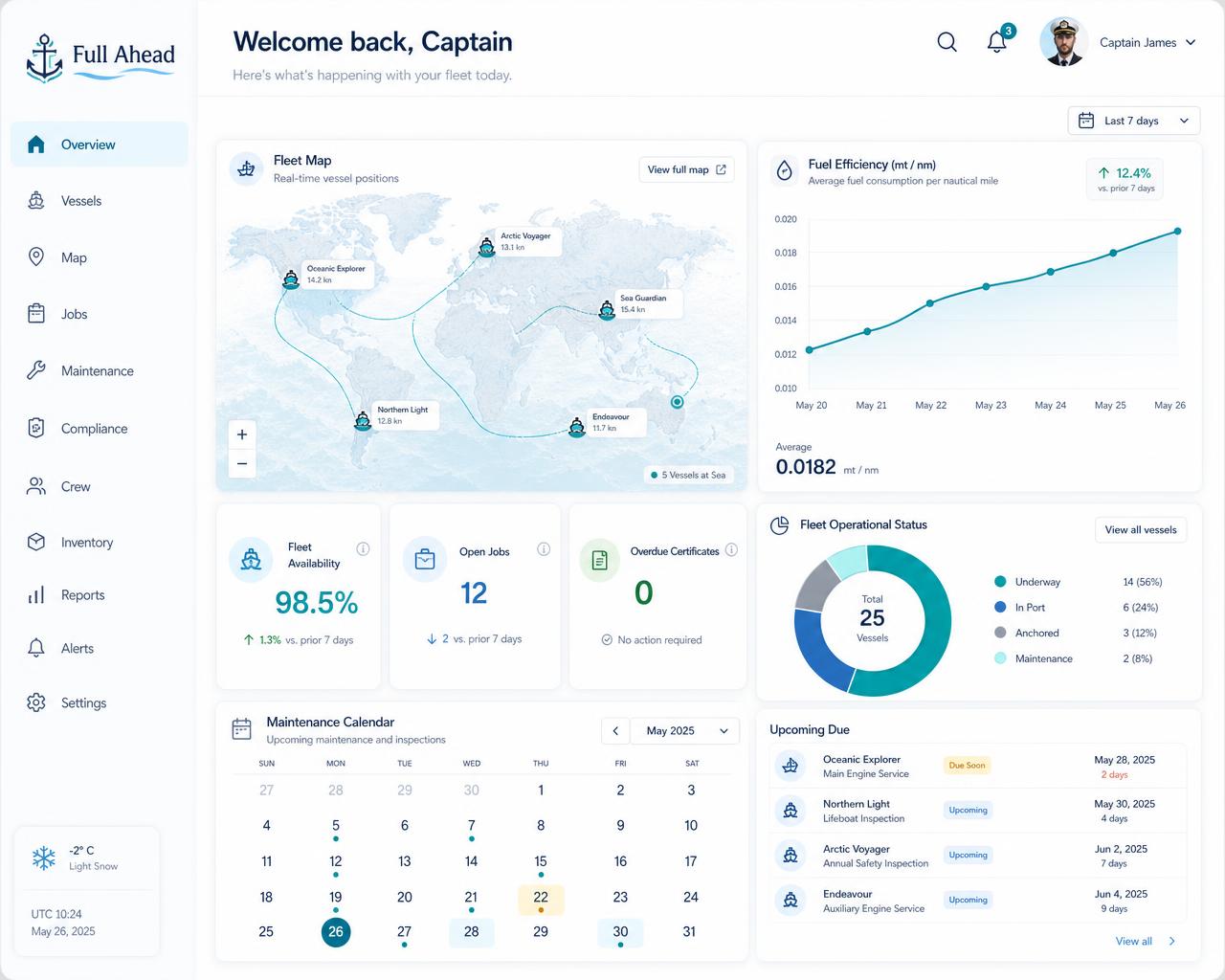
The loop that static software does not have.
1 · Predict, on the record
Every forecast is written down before the fact: this job will finish by its due date, this certificate will be renewed before it lapses, this drift is real, this recommendation is the right call. Nothing is quietly forgotten.
2 · Check against reality
Once the review horizon passes, the platform reads your own records and scores the prediction — hit, partial or miss — with the slip in days and the reason attached.
3 · Re-tune the lead times
Warnings that landed late get a longer lead time. Alerts that cleared themselves get a higher threshold. The correction is applied automatically, per fleet, per dimension.
4 · Compound
Each cycle makes the next set of warnings sharper. Accuracy is published in your own console, so you can see the curve rather than take a vendor's word for it.
Four dimensions, scored from your own recorded outcomes.
Maintenance completed on time
Did the job actually close by its due date, and by how many days did it slip? Persistent slippage on a job class pushes its warning earlier rather than leaving the superintendent to notice the pattern.
Certificate renewed before expiry
Did an ISM, ISPS, SOLAS, MARPOL, MLC or class certificate get renewed in time, or lapse? A lapse extends the renewal window for that convention across the fleet.
Copilot recommendation accepted
Did a qualified human approve the recommended option, choose a different one, or reject it? Operator behaviour reweights how future options are ranked — the crew teaches the model, not the other way round.
Condition alert was real
Did the drift lead to intervention, or settle by itself? False alarms raise the threshold, because an alert nobody trusts is worse than no alert at all.
The loop never overrides a human. It changes how early you are warned and how honestly confidence is reported — every deferral, approval and interval change stays a recorded decision by an authorised person, ready for ISM audit and PSC inspection.
Frequently asked
Honest AI · what this feature actually is
Three kinds of “AI”. We name which one you are getting.
Predictions are deterministic arithmetic; the loop that re-times warnings is bounded statistical calibration over your own outcomes. No language model is involved in a prediction.
Published arithmetic over your own records. Same inputs, same score, every time — traceable back to the row that produced it.
Used here
Bounded, auditable corrections to lead times, computed inside your workspace from your own outcomes. No model weights change and nothing is trained on your data.
Used here
Third-party models draft text only. Nothing they produce is applied automatically — a qualified person accepts, edits or rejects it.
Not used here