Human factor · field note
The search for signal
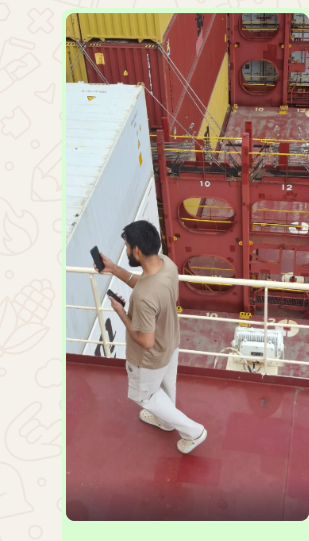
One photograph of an off-duty seafarer walking the deck with two devices, looking for a bar of signal. It is the most common unlogged activity at sea, and it happens inside the hours a rest record counts as rest.
What the photograph shows
A man on his off-watch, in his own clothes, walking the length of a container stack with a phone in one hand and a tablet in the other, holding them up the way you hold something to the light. He is not working. He is trying to reach his family.
Every seafarer recognises the walk immediately, and almost nobody ashore has ever seen it. It happens in the hour that is supposed to be rest, in the part of the day a rest-hours record counts as rest.
Why this is a safety question and not a welfare nicety
Rest is not the absence of duty. Rest is recovery, and recovery only happens when the mind lets go of what it is carrying. A crew member who cannot find out whether a parent's operation went ahead, whether a child started school, whether a payment cleared, does not stop carrying it when the watch bell goes. He carries it onto the next watch.
That is the mechanism. Not tiredness in the cartoon sense of falling asleep at a console, but attention already committed elsewhere before the shift begins. The rest-hours record shows compliance. The attention account is overdrawn, and nothing in the paperwork can see it.
The regulatory frame is catching up slowly — MLC 2006 amendments have pushed social connectivity from a courtesy toward an expectation — but the operational reality on many hulls is still a walk around the deck with two devices held above your head.
The inversion nobody plans for
Connectivity at sea is not evenly bad; it is unevenly good. Bandwidth is prioritised for operations, and operations follow the office's clock, not the crew's. The window when the shore side is loudest — reporting, requisitions, class correspondence, charterer queries — is frequently the same window a crew member would need to call home.
So the demand curve runs inverted against the ship's worst hours. Arrival, departure, bunkering, a survey week: precisely when the plant needs undivided attention is when the pipe is fullest and the personal window is smallest. That collision is schedulable, which means it is also avoidable.
What a system can actually do about it
Nothing here requires a wearable, a camera or a biometric. We do not use them, and we will not.
It requires three unremarkable things. First, know when the ship is attention-poor: crew change, survey week, first days of a relief, back-to-back port calls. Second, know when the plan is loading attention-heavy jobs on top of those windows — that is a planning error visible on the plan, while it can still be moved. Third, treat the link itself as a scheduled resource, so the operational burst and the crew's window are not competing for the same minute of the same pass.
None of that is welfare theatre. It is the same discipline we apply to spares and to surveys, pointed at the resource that actually executes every other control on board: human attention.
Why publish a photograph rather than a statistic
Because the statistic already exists and changes nothing. Every fatigue study in the last two decades says the same thing, and every rest-hours record on every ship says compliance. The gap between those two facts is where this photograph lives.
No vessel, no company, no port and no face that identifies a person is asserted here. What is shown is a pattern anybody who has sailed will recognise on sight — and that recognition is the entire argument.