Vessel maintenance software
Vessel maintenance software your crew can actually use at sea.
Running-hours and calendar triggers on every piece of equipment, defects tracked to close-out, and photographic evidence captured with no connectivity at all. Written by a Chief Engineer who kept these records by hand. From €149 per month, with a 30-day parallel review.
- Works fully offline
- No per-vessel licence
- Audit-ready evidence
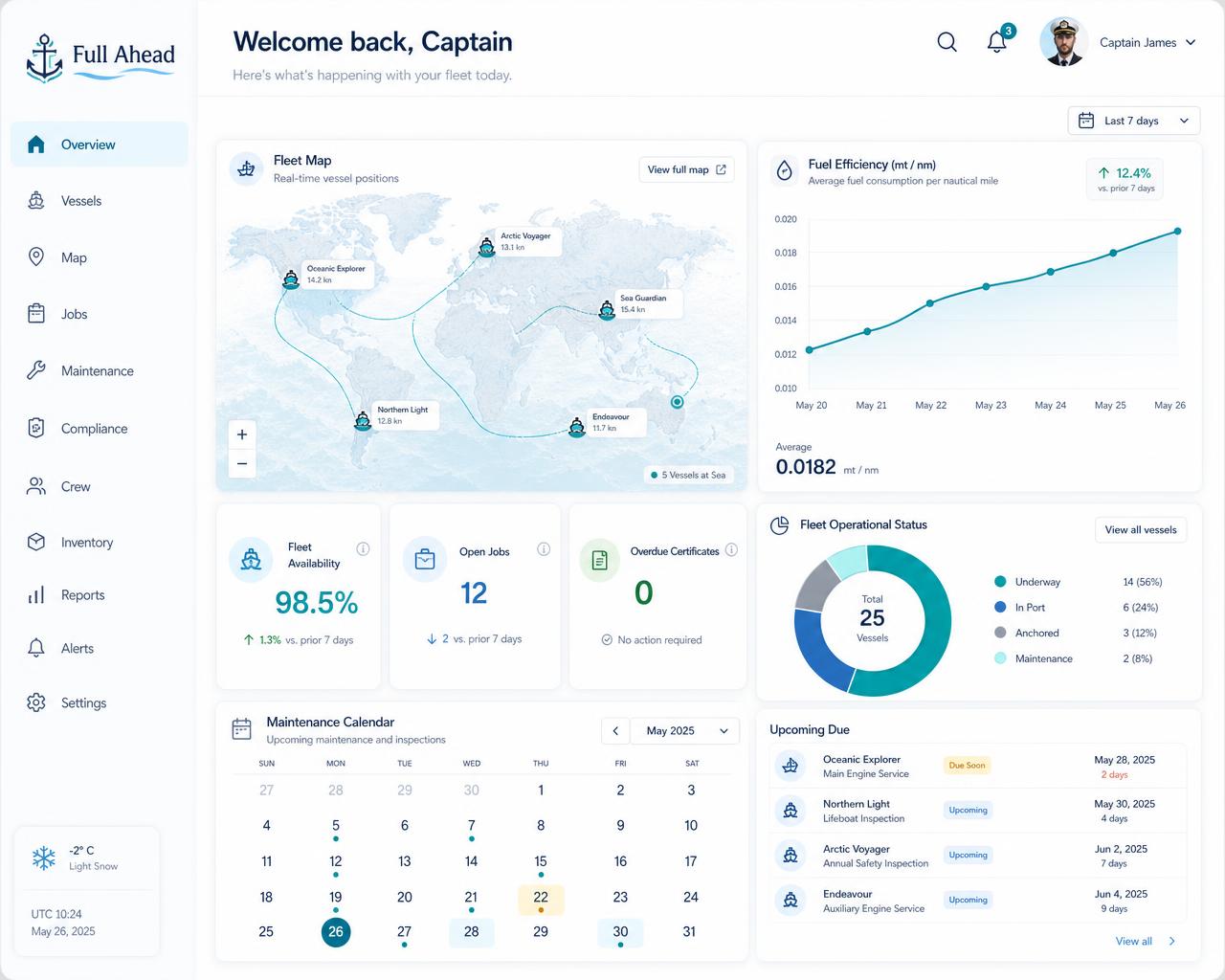
Everything a marine PMS has to do.
Maintenance software fails at sea for one of two reasons: it needs a connection the vessel does not have, or it records the schedule without the proof. Full Ahead Maritime is built around both problems.
Equipment register
Every machine, system and critical spare on the vessel, with makers' data, criticality and the jobs raised against it in one record.
Running hours & calendar
Dual triggers per job — whichever falls due first raises the work order, with tolerance windows you control.
Defects & inspection dates
Raise a defect from any job and track it to close-out. Inspection and survey dates are shown against the vessel with a day count when you look; nothing is sent to warn you in advance.
Condition monitoring
Log vibration, temperature and pressure readings against equipment and see trends before failure, not after.
Offline evidence capture
Checklists, readings and photographs recorded at sea, queued in a sync outbox and uploaded automatically while the app is open.
Append-only log of schedule, sign-off and reading changes
Creations, evidence uploads and the nightly certificate expiry check are written to an append-only log with the user and a timestamp. An edit to a maintenance schedule, a sign-off or a sensor reading is recorded field by field, old value to new value. Edits to certificates, documents and drills are not captured there yet.
How to choose vessel maintenance software: eight questions.
Every marine PMS demo looks the same in an office. These are the questions that separate them once the ship is at sea and an inspector is on the gangway. Ask them of us and of anyone else on your shortlist.
- 1
Does it work with the vessel offline for days, not minutes?
Most failures are here. A cached read-only copy is not the same as raising, completing and evidencing a job with no link at all and syncing later without overwriting the office.
- 2
Can one job carry both a running-hours and a calendar trigger?
Machinery does not respect one clock. If the system forces a single interval per job, the crew will keep the real schedule somewhere else.
- 3
Is the evidence attached to the job, or filed separately?
An auditor asks for proof of a specific job on a specific date. Evidence stored in a shared drive beside the PMS is what turns a five-minute answer into a two-hour search.
- 4
Can anyone silently change a due date or a sign-off?
If overdue work can be back-dated without trace, the record has no value in a vetting inspection. Change a due date or a sign-off in Full Ahead Maritime and the change log shows the field, the old value, the new value, the person and the time — including a change made back again. Ask to see it. Edits to certificates, documents and drills are not captured there yet, and we say so rather than let you find out.
- 5
What does it cost per vessel, all in, for three years?
Compare licence plus implementation plus per-user and per-module fees. Headline pricing rarely survives the first quotation.
- 6
How long before the crew is entering data unassisted?
If training takes more than an afternoon, adoption will fall back to the spreadsheet the moment the superintendent leaves the ship.
- 7
Does maintenance connect to the statutory side?
Surveys, certificates and MARPOL entries are driven by the same events as maintenance. Two disconnected systems means two sets of dates that disagree.
- 8
Can you export everything you put in?
Your maintenance history is your asset. Confirm a full CSV or API export exists before you make three years of records dependent on one vendor.
What one job record holds
- Trigger
- 500 running hours or 12 months, whichever falls first
- Equipment
- No. 2 diesel generator — criticality: critical
- Evidence
- Two photographs, crankcase deflection readings, lube-oil sample reference
- Sign-off
- Second Engineer at completion, Chief Engineer at verification
- Audit trail
- Date, tolerance and sign-off changes, with author and timestamp; readings are recorded as new entries, not edited in place
- Linked requirement
- Class survey item and SMS planned-maintenance record
Spreadsheet, legacy PMS, or Full Ahead Maritime.
A fair reading of the three options most technical departments are actually choosing between. Legacy systems vary; check each row against your own quotation rather than taking ours on trust.
| Capability | Spreadsheet | Legacy marine PMS | Full Ahead Maritime |
|---|---|---|---|
| Running-hours + calendar on one job | |||
| Full function with no connectivity | |||
| Photographic evidence on the job record | |||
| Tamper-evident change history — verified through published checkpoints | |||
| Statutory and survey dates linked | |||
| Live within a day, no implementation project | |||
| Published price, no per-user fee |
Key: tick — supported as standard · dash — partial or chargeable · cross — not available. Switching from a named system? See the BASSnet switch guide or the full alternatives comparison.
On the tamper-evident change history row: the checkpoint records when the change history was sealed, not when the underlying work was done. A change is covered by a checkpoint only once it has been sealed into one, so entries written since the last seal are outside every published checkpoint. The sealing rule can only be removed with a database-owner credential. Verify it yourself on the public checkpoint page.
Maintenance and compliance on the same record.
A maintenance job and a statutory requirement are usually the same event seen from two sides. Full Ahead Maritime links the planned maintenance system to the safety management registers for ISM, ISPS, SOLAS and MARPOL, so closing a job also satisfies and evidences the certificate behind it. Check your dates against the statutory interval reference and the 2026–2030 regulatory deadline map, or read more about compliance automation, predictive maintenance and the wider ship management platform.
Vessel maintenance software questions.
Get your maintenance schedule out of the spreadsheet.
Add a vessel and it arrives with a full equipment register and job skeleton already in place. Start with a 30-day parallel review alongside your current system.