Planned maintenance system
Simplify complex maintenance through prediction.
Full Ahead Maritime turns dense PMS schedules into a calm, prioritised workflow. Running-hours, calendar and condition triggers surface the right job before machinery breaks, while evidence, spares and critical-equipment tracking stay audit-ready — even offline at sea. From €149 per month, 30-day parallel review.
- ISM-aligned records
- Works offline at sea
- Import your existing PMS
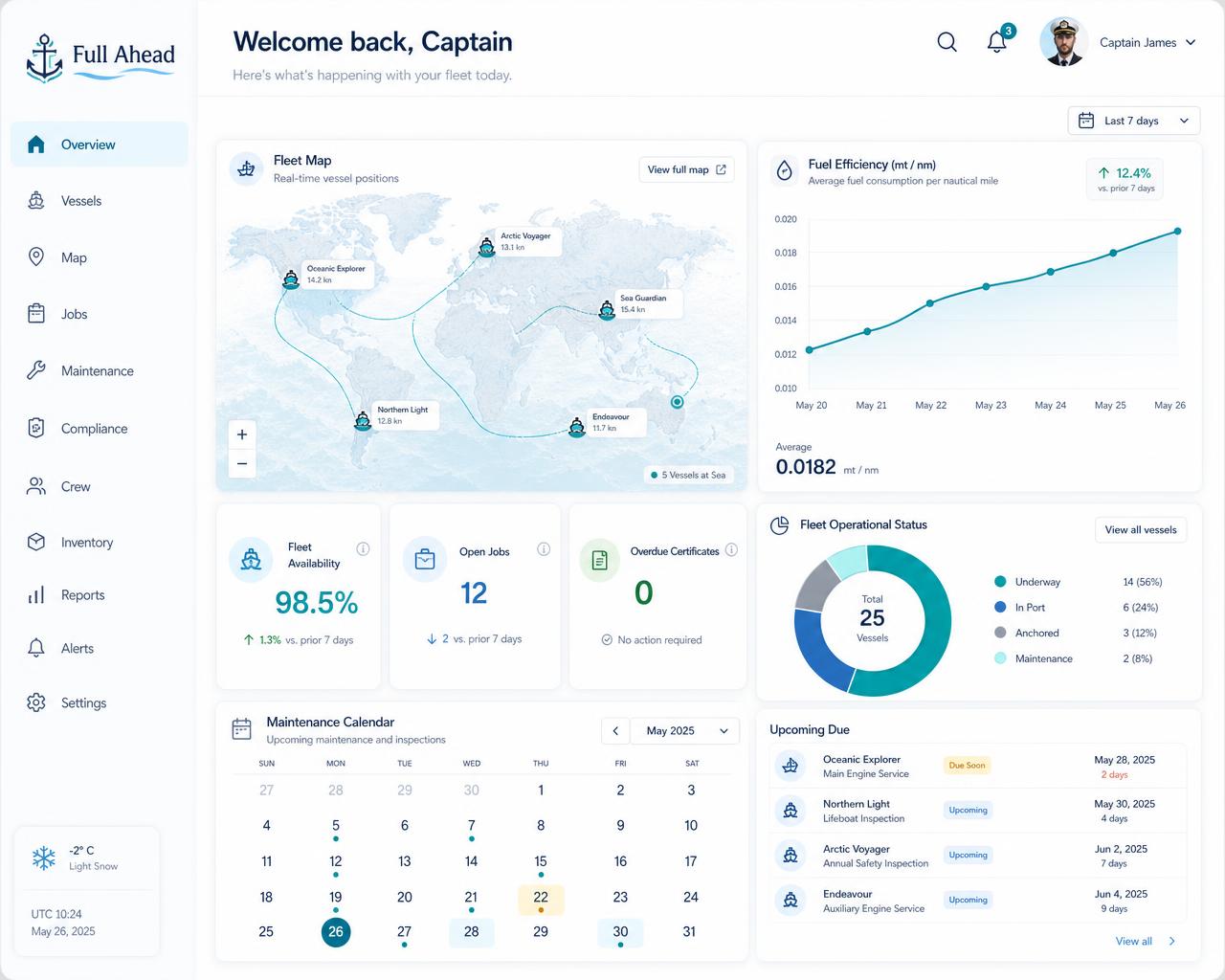
What a marine PMS has to cover.
A planned maintenance system fails for one of two reasons: it is too heavy for the crew to keep current, or it cannot prove what was done when a surveyor asks. Full Ahead Maritime is built against both.
Equipment register & hierarchy
Ship, system, machinery and component levels with makers, serials, drawings and manuals attached where the engineer needs them.
Calendar, running-hours & condition triggers
Several triggers per item, whichever falls first raises the job. Running hours are entered as a counter reading; a replaced counter that restarts low has to be corrected by hand.
Critical equipment under ISM
Critical items carry their own criticality and deferral controls, and a critical job past its due date shows as overdue on the job list, the dashboard and the readiness view. There is no separate alert for it.
Jobs, defects & deferrals
Work orders with sign-off, and open defects carried as tracked items with risk assessment, mitigation and due date.
Audit-ready evidence library
Photos, readings and signatures attached to the job itself, so a survey pack is exported rather than reconstructed.
Full function offline at sea
The whole register and job list works with no connectivity; queued work uploads in order when the link returns, while the app is open.
Predictive simplification
Why prediction makes the complex feel simple.
A ship generates thousands of maintenance data points: running hours, oil samples, temperatures, due dates, certificates, defects, spares levels. Without prediction, the superintendent is the filter. With Full Ahead Maritime, the platform surfaces only the items that need attention now, ranked by risk and consequence.
- Each job carries its own trigger — calendar, running hours or condition — and shows as due against whichever fires first. A person closes it and raises the next occurrence.
- Overdue and high-risk items are highlighted; routine items stay in the background.
- Engineers see today's work, not the whole plan, so adoption is natural.
- Shore teams get a readiness dashboard instead of chasing spreadsheets.
The result for the engineer at sea
Instead of hunting through a 200-page PMS manual or a shared folder, the engineer opens the app, sees the jobs due today, records readings and photos, and moves on. The record of what was closed, when and by whom stays with the job. Closing a calendar job raises the next occurrence with its due date; nothing warns the office in advance of that date.
The result for the superintendent
A single readiness score and a filtered risk list replace the morning status-call. When class, flag or a charterer asks for proof, the survey pack is exported from the records already held rather than reconstructed.
From spreadsheet to a working register in four steps.
1. Build the register
Import or enter equipment down to component level, with criticality set per item, from an existing spreadsheet or by hand.
2. Set the intervals
Attach maker intervals, running-hours limits and condition thresholds. A calendar job raises its next occurrence when a person closes the current one; the plan ahead is what has been entered, not a generated twelve months.
3. Work it from the vessel
Engineers see today's jobs on the ship app, close them with readings and photos, and log defects — with or without connectivity.
4. Prove it ashore
The office sees overdue and deferred work per vessel in real time, and exports the survey pack when class, flag or a charterer asks.
Where the PMS sits in the wider system.
The maintenance plan is the centre of the vessel record, not an island. Full Ahead Maritime links it to the ISM, ISPS, SOLAS and MARPOL registers, to performance monitoring so a fuel deviation can raise a job, to predictive maintenance for critical machinery, and to crew records so the person who signed off the work is traceable. The whole thing runs on one ship management platform.
Free download
The PMS & ISM audit-readiness checklist.
Thirty-eight checks across the equipment register, intervals, critical equipment, deferrals and evidence — the points class, flag and port state control ask about most often, plus a five-step audit rehearsal. One vessel, one hour, one honest pass.
- Equipment register & criticality
- Running-hours & condition triggers
- Critical equipment test regime
- Deferrals & risk assessments
- Evidence a surveyor accepts
- Pre-attendance rehearsal
Planned maintenance system questions.
Put one vessel on it this week.
Import the equipment list, set the intervals, and run it in parallel for a cycle. Every plan starts with a 30-day parallel review.
Referenced evidence
Choosing a planned maintenance system is partly a question about what happens when the plan changes. The evidence object below states what the ISM Code requires of maintenance records, what Full Ahead Maritime preserves when a due date or tolerance moves, and what it does not claim.
When planned maintenance moves: what should the record preserve?
Every planned maintenance system lets a due date move. Fewer preserve the decision that moved it. This object sets out what the record should hold when maintenance is re-timed, and what is actually preserved in Full Ahead today.